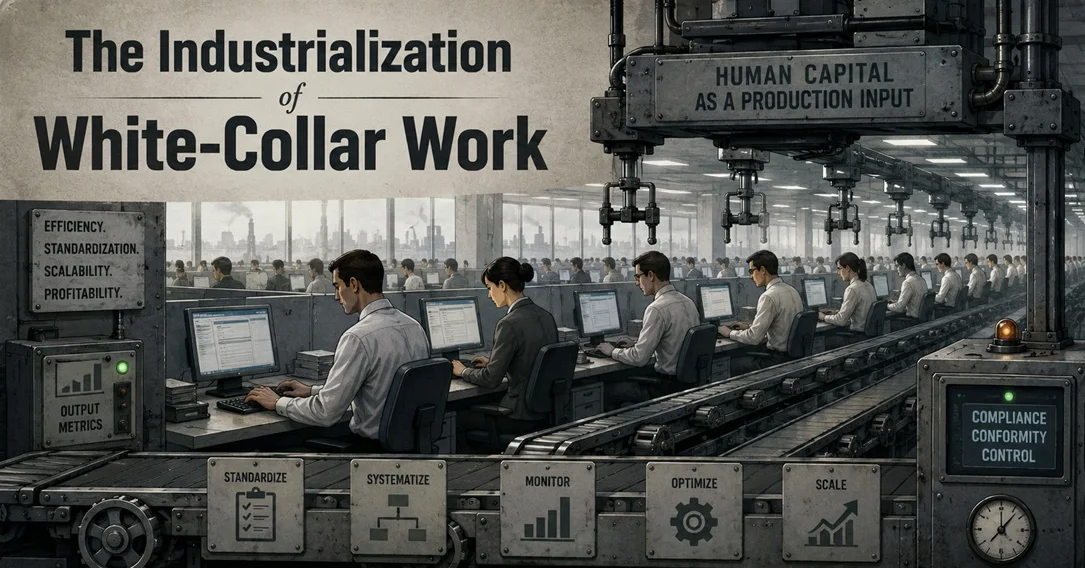
Go back 200 years. A skilled craftsman spent weeks making a single item. The craft was real. Then the factory arrived — not to make better craftsmen, but to make them unnecessary for that task. The assembly line eliminated work that could be broken into steps and handed to a machine. AI is doing the same thing. This time, the factory floor is the laptop screen.
The clearest signal of a job at risk: can it be described as rules applied to an input to produce an output? If yes, it is automatable — not in theory, but now. AI tools already draft legal documents, reconcile accounts, generate marketing copy, screen applicants, and produce research summaries. These are not fringe capabilities. They are being deployed at scale across every major industry.
The people most exposed are not entry-level workers — many of those jobs were already precarious. The most exposed are mid-level knowledge workers who built careers on reliable, repeatable expertise: the analyst who produces the weekly report, the associate who prepares the first draft, the coordinator who manages information flow. These roles were once the engine of upward mobility. They are now the first candidates for replacement.
The right question is not whether this will happen — it is happening. The real question is: what work is genuinely, irreducibly human? And how do people and organizations prepare for a world where that answer determines everything?
The factory didn’t wait for society to be ready. Neither will this.
Workshift · Opinion Section · May 2026.
All statistics are illustrative projections for editorial purposes.
Written by AI · Conceptualized by Manoj Sasidharan Pillai.