

Like a friend who shares the news over tea — no jargon, no fluff, just what matters across the Gulf.
Ai MAJLiS Editions
- Issue 17 - 21 September 2026
- Issue 16 - 14 September 2026
- Issue 15 - 7 September 2026
- Issue 14 - 24 August 2026
- Issue 13 - 17 August 2026
- Issue 12 - 10 August 2026
- Issue 11 - 03 August 2026
- Issue 10 - 27 July 2026
- Issue 09 - 20 July 2026
- Issue 08 - 13 July 2026
- Issue 07 - 06 July 2026
- Issue 06 - 29 June 2026
- Issue 05 - 22 June 2026
- Issue 04 - 15 June 2026
- Issue 03 - 08 June 2026
- Issue 02 - 01 June 2026
- Issue 01 - 25 May 2026

ISSUE 06, 29 June 2026
Ai MAJLiS
- UAE
- SAUDI ARABIA
- QATAR
- KUWAIT
- BAHRAIN
- OMAN
YYallah, ahlan — welcome to Issue #006 of Ai MAJLiS. The UAE this week did something no government has done before: it gave its official spokesperson job to an AI. Meet Zayed — and Saeed, Dubai Municipality’s AI face. And — right here in Ras Al Khaimah — Inspire Meta IT Solutions just wrapped a two-day Claude AI Boot Camp at the University of Greater Manchester. We have the photos and the full story. Saudi Arabia published what may be the most honest self-assessment of any Gulf AI programme so far: the infrastructure is built, now comes the hard part. A new Deloitte report confirms what many Gulf leaders suspect — 84% of organisations haven’t redesigned their workflows around AI yet. Khawa’s ready. Let’s go.
01
UAE - AI Avatars · Government Communications
Meet Zayed and Saeed: The UAE's AI-Generated Government Spokespeople Are Here
The Gulf’s most talked-about AI story this week didn’t come from a data center or a sovereign fund. It came from two AI-generated faces — and what they represent about where government communications are heading.
On June 18, the International Affairs Office at the UAE Presidential Court launched Zayed — an AI-powered spokesperson designed to communicate the Office’s initiatives, strategic priorities, and global engagements. Named after the UAE’s founding father, Sheikh Zayed bin Sultan Al Nahyan, the remarkably lifelike digital figure will represent the UAE to domestic and international audiences through AI-generated content. The initiative sits under the UAE Strategy for Artificial Intelligence 2031.
Just days earlier, Dubai Municipality unveiled Saeed — its own AI-powered virtual spokesperson with Emirati features and attire, a clear Arabic voice, and multilingual capabilities including English, designed to enhance digital communication with residents and visitors across Dubai.
"The UAE's journey in artificial intelligence is rooted in a clear vision set by our leadership — a vision that sees innovation not simply as technological advancement, but as a force that empowers societies and strengthens human connection."
— Mariam bint Mohammed Almheiri, Head of International Affairs Office, UAE Presidential Court, June 18, 2026
This isn’t just novelty. The UAE has already launched its first wave of AI agents across government services — in tax auditing, procurement, customer happiness, and technical support. Zayed and Saeed represent the communications layer of the same transformation: government using AI not just to process requests, but to speak.
- What to Watch
While governments around the world are experimenting with AI avatars, few have deployed them as official representatives of government entities at this scale or seniority. Questions of transparency, accountability, and public trust are still being worked through — but the UAE has moved first. Watch for other GCC governments to follow within 12 months.
Why it matters: AI-generated government communications at this level are a first globally. For businesses in PR, public affairs, AI content, and government technology, this signals a rapidly growing category. The question of how to verify, audit, and govern AI-generated official communications is one regulators globally haven’t yet answered — and the UAE is writing the first chapter.
02
RAK UAE - From Our Community · AI Education
A Claude AI Boot Camp Just Completed in Ras Al Khaimah — Right Here in the Gulf
While this issue was being put together, something quietly significant happened in Ras Al Khaimah. On June 27–28, 2026, Inspire Meta IT Solutions conducted a Claude AI Boot Camp at the University of Greater Manchester Academic Centre, RAK — a two-day hands-on programme led by Master Trainer Akhil Raj.
The boot camp brought together a diverse cohort of professionals — engineers, analysts, and business leaders — for deep, practical training on using Claude AI for real-world applications. The sessions ran across two full days, covering AI fundamentals, prompt engineering, workflow integration, and how to deploy Claude as a productivity multiplier in professional settings.
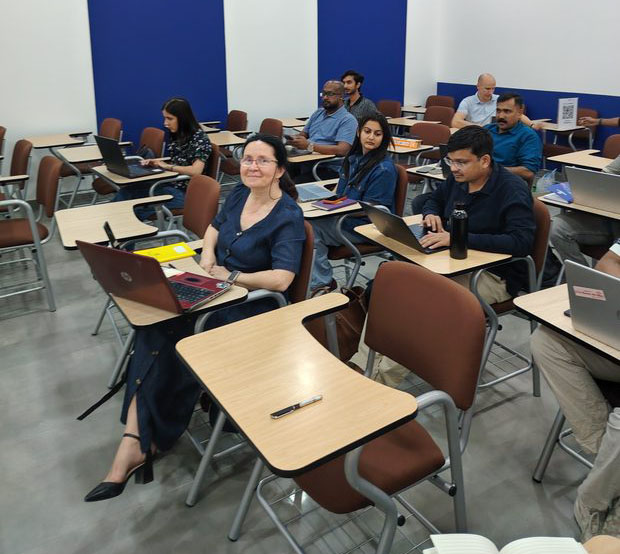
Day 1 in progress — participants working with Claude AI at the University of Greater Manchester Academic Centre, RAK.
The choice of the University of Greater Manchester’s RAK campus as the venue is itself a signal. This campus — one of the most recently established UK university presences in the UAE — is actively positioning itself as a hub for professional development and continuing education in the Northern Emirates. Running a cutting-edge AI boot camp here extends the region’s AI upskilling footprint beyond Dubai and Abu Dhabi.
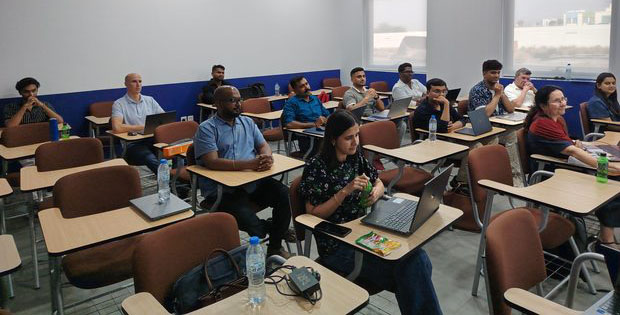
Day 2 — a fuller room as word spread. Participants came from across the UAE to attend.
The programme is part of Inspire Meta IT Solutions’ broader mission to make advanced AI training accessible across the Gulf — not just in the major hubs. With UAE-wide AI adoption now at 70.1% and the government mandating AI integration across federal ministries, ground-level training programmes like this one are the human capital layer that turns national strategy into operational reality.
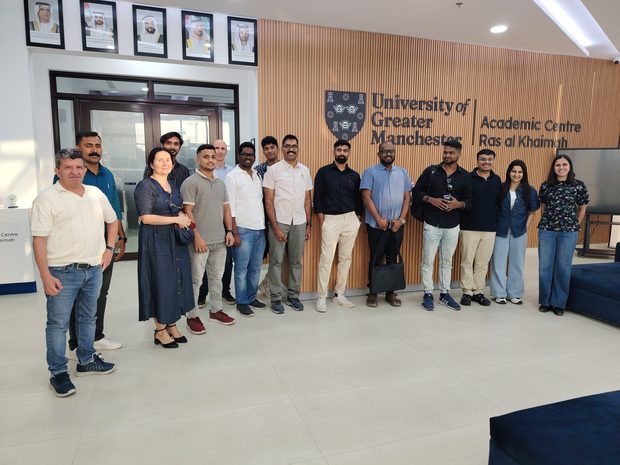
The full cohort at the close of the boot camp — in front of the University of Greater Manchester, Academic Centre Ras Al Khaimah sign.came from across the UAE to attend.
Why it matters: The Gulf’s AI ambition will only be realised if the human layer keeps pace with the infrastructure layer. Boot camps like this one — practical, accessible, geographically distributed — are exactly how that happens. If you’re running AI training, workshops, or community events across the GCC, we’d love to hear from you and feature it in a future edition of Ai MAJLiS. This newsletter is for the whole Gulf — from Abu Dhabi to Muscat, and Ras Al Khaimah to Manama.
Learn more: metamindinspire.com/etn/claude-boot-camp-in-rak · Trainer: akhilrajsl.online
03
SAUDI ARABIA - Enterprise AI · Implementation
Saudi Arabia's Honest Reckoning: The Infrastructure Is Built. Now Comes the Hard Part.
Arab News published this week what may be the most candid assessment of any Gulf AI programme: Saudi Arabia has officially moved from the investment phase to the implementation phase — and the challenge has fundamentally changed.
“The biggest challenge is no longer access to technology,” said Zainab Al-Amin, Vice President of National Digital Transformation at Microsoft Arabia. “Organizations move from experimentation to scale when AI is tied to a clear business priority, supported by the right data and governance, and embedded into the operating model rather than treated as a standalone pilot.”
The proof points are real. Obeikan Manufacturing has connected more than 1,200 machines and 280 production lines, using AI to predict downtime and improve operational efficiency by up to 30%. Riyadh Air selected Microsoft Azure for its core digital infrastructure. ACWA Power is using AI to optimize energy and desalination processes. Qiddiya is using Microsoft 365 Copilot across contractors, assets, and financial workflows.
1200
Obeikan machines connected via AI
30%
Operational efficiency improvement
1.6M+
Saudis trained in AI, cloud & data skills
IBM CEO Arvind Krishna, speaking to Asharq Al-Awsat at IBM Think 2026 in Boston, framed Saudi Arabia’s next phase bluntly: “Computing power is no longer the main bottleneck. The bigger challenges are now AI-ready data, governance, and enterprise execution.” He noted that the sectors closest to moving AI into production are banking and financial services, telecommunications, energy, and government — and that progress in those sectors depends on data maturity and regulatory clarity.
Separately, Saudi Arabia adopted an international document this week outlining principles for the ethical use of AI in media, in partnership with SDAIA — announced at the European Broadcasting Union General Assembly in Prague, where the Arab States Broadcasting Union called for unified global positions on AI and media rights.
Why it matters: Saudi Arabia’s AI story is entering its most commercially important chapter. The era of headline announcements is giving way to the era of delivery. For enterprise technology companies, systems integrators, and AI governance consultants, the Saudi market is about to generate its most substantial wave of commercial AI procurement — tied directly to measurable operational outcomes.
04
GCC WIDE - Enterprise AI · Research
84% of Middle East Organisations Haven't Redesigned Their Workflows Around AI — Deloitte
The Gulf’s AI implementation gap got its clearest quantification yet this week. Deloitte’s State of AI in the Enterprise report, with Middle East-specific findings just released, confirms that despite the region’s enthusiasm and investment, 84% of organisations have not yet redesigned jobs or workflows around AI capabilities.
Instead, most are focused primarily on improving general AI literacy and employee education — valuable, but not the same as the fundamental operating model redesign that creates measurable competitive advantage. The report’s authors are blunt: “Insufficient workforce skills are now considered the single biggest barrier to integrating AI effectively into day-to-day business operations.”
There is a genuinely positive signal in the data: the Middle East is identified as a bright spot for AI interest and investment globally, with enterprise AI access in the region expanding by 50% over the past year. The UAE and Saudi Arabia are driving the headline numbers — but the implementation gap is regional.
84%
Haven't redesigned workflows for AI
50%
Enterprise AI access growth in the Middle East YoY
21%
Have mature governance for autonomous AI
"AI transformation is ultimately a human transformation. Technology alone will not create competitive advantage. Organizations must rethink how work gets done, how teams are structured, and how employees collaborate with increasingly intelligent systems."
— Deloitte, State of AI in the Enterprise — Middle East Edition, June 2026
Perhaps most striking: only 21% of organisations currently report having mature governance models for autonomous AI systems — raising serious concerns around oversight, accountability, and operational risk as agentic AI deployment accelerates across the GCC.
05
QATAR & GCC - AI & Media · Digital Governance
Qatar Declares AI a Core Pillar of National Competitiveness — While Arab Broadcasters Unite on Media Rights
Qatar Tribune this week published a landmark statement from the country’s national AI agenda: Qatar has placed AI at the heart of its digital transformation plan, positioning it explicitly as a pillar of global competitiveness in line with Qatar National Vision 2030.
Qatar’s AI readiness score of 63.59 in the Oxford Insights Global AI Readiness Index places it third in the GCC — behind the UAE (70.42) and Saudi Arabia (67.04), but ahead of Oman (58.94), Bahrain (56.13), and Kuwait (49.86). The Qatar Development Bank’s sector report, released this week, highlights the country’s active integration of AI across finance, manufacturing, smart cities, and everyday services — with the GCC AI market projected to grow from QR12.4bn to QR56.3bn by 2030.
Qatar’s Qai — the QIA-backed sovereign AI entity — continues to deepen its national mandate, while ROBOTECH 26 (October 27–29, Doha) is shaping up as the Gulf’s most significant robotics and AI industry event of Q4 2026.
On the broader Arab media front, the Arab States Broadcasting Union — representing Arab Group members including all six GCC broadcasters — called at the EBU General Assembly in Prague for a unified international position in negotiations with global tech and AI companies, to protect the rights of media organizations and ensure fair partnership in the use of media content. Saudi Arabia, notably, adopted a new international document outlining principles for the ethical use of AI in media — a concrete step in formalising these protections.
- Opportunity Spotlight
The Arab broadcasting community’s call for AI media rights frameworks is the opening of a regulatory conversation that will reshape how AI companies can use Arabic-language media content. For AI companies reliant on Arabic media data for training — and for media organisations seeking licensing revenue from AI — this is a story to follow very closely through the rest of 2026.
Why it matters: Qatar’s AI positioning is becoming more specific and commercial, not just strategic. Combined with the Arab media rights push, this week’s developments sketch out a region that is increasingly asserting its own terms for AI development — not just adopting global frameworks wholesale.
06
KUWAIT - BAHRAIN - OMAN : AI Practitioners — Weekly Check-In
The Quiet Three: Kuwait, Bahrain, and Oman Are Moving — Just Not at the Same Volume
No single breaking story dominated Kuwait, Bahrain, or Oman’s AI agenda this week — but that silence is itself a story worth telling. As the UAE launches AI spokespersons and Saudi Arabia publishes honest implementation assessments, the GCC’s “AI Practitioner” trio continues building steadily in the background.
Kuwait’s Minister of State for Communications Affairs Omar Al Omar summarised the country’s stance at the Digital Cooperation Organisation: “We are setting the foundation for better things to come.” Kuwait’s Microsoft digital skills programme — aimed at training citizens in AI and cloud technology — is ongoing, and the New Kuwait 2035 vision continues to frame all AI investments around citizens’ quality of life, not technology for its own sake. Kuwait’s AI readiness score of 49.86 in the Oxford Insights index is the lowest in the GCC — underlining the infrastructure gap documented across the past six issues.
Bahrain continues to distinguish itself on governance. Its standalone AI law — still in progress through the Shura Council — would be the most binding AI regulatory framework in the GCC. Bahrain’s Central Bank sandbox model remains the most active in the region for fintech and AI financial products. Oxford Insights scores Bahrain at 56.13, ahead of Kuwait and Oman.
Oman is executing quietly on its differentiated strategy. Ali Al Shidani, Oman’s Undersecretary of Communications and Information Technology, confirmed this week: “We successfully implemented AI pilot projects across priority sectors such as health, education, justice, procurement and governance. AI is no longer a future concept. It is actively shaping public services, economies and societies.” Oman’s semiconductor-focused positioning and Gulf of Oman terminal infrastructure remain distinctive advantages in the region’s AI buildout.
GCC AI SNAPSHOT
Where Each Country Stands This Week
UAE
AI-nativeSaudi Arabia
ImplementingQatar
PositioningKuwait
FoundationBahrain
GoverningOman
ExecutingSix issues in, a pattern is crystallising. The UAE and Saudi Arabia have lapped the field on ambition and infrastructure — but they’re now confronting the same challenge as every other AI market in the world: the gap between deployment and transformation. Zayed and Saeed are genuinely remarkable. So is Obeikan connecting 1,200 machines. But 84% of regional organisations haven’t yet redesigned how they work around AI — and that number is the real frontier.
Kuwait, Bahrain, and Oman aren’t standing still. They’re doing what the bigger players often can’t: building deliberately, at human scale, on their specific strengths. That may prove to be the smarter strategy over a five-year horizon.
That’s our majlis for this week. If this landed well with you, share it with someone who’s building in the Gulf — or trying to understand it from the outside. Ramadan is coming, and so is the next edition. Inshallah, see you Sunday. 🫖